


Most companies start with the same question:
How do we show up on Google?
It sounds reasonable. But it skips an important step. Before you can influence search results, it helps to understand what Google is actually doing.
“Almost universally, new clients come in with at least one fundamental misconception about how search works. The most common one I hear is that SEO is something you can ‘set and forget.’ That if you do the right things once, you’ll rank and stay ranked. The reality is that Google is constantly re-evaluating every page on the internet, and your position is always relative to what your competitors are doing.”
— Jen Merritt, Think It First Strategy Lead
Search engines are not randomly pulling pages from the internet. They follow a structured process to discover websites, organize information, and decide which pages best answer a user’s search.
That process is surprisingly logical once you see it. Understanding these search engine basics changes how businesses think about their websites, their content, and their marketing investments.
Instead of chasing rankings blindly, companies can make better decisions about how their site is built and what information it publishes.
What Is a Search Engine?
At its core, a search engine is a tool designed to help people find information on the internet.
Search engines constantly scan the web, organize the information they discover, and return the pages that best answer a user’s question.
Behind the scenes, this process happens in three main steps:
- Crawling: Bots discover and scan pages on the web
- Indexing: Content is stored and organized in a library
- Ranking: Algorithms decide which pages are the most relevant to show
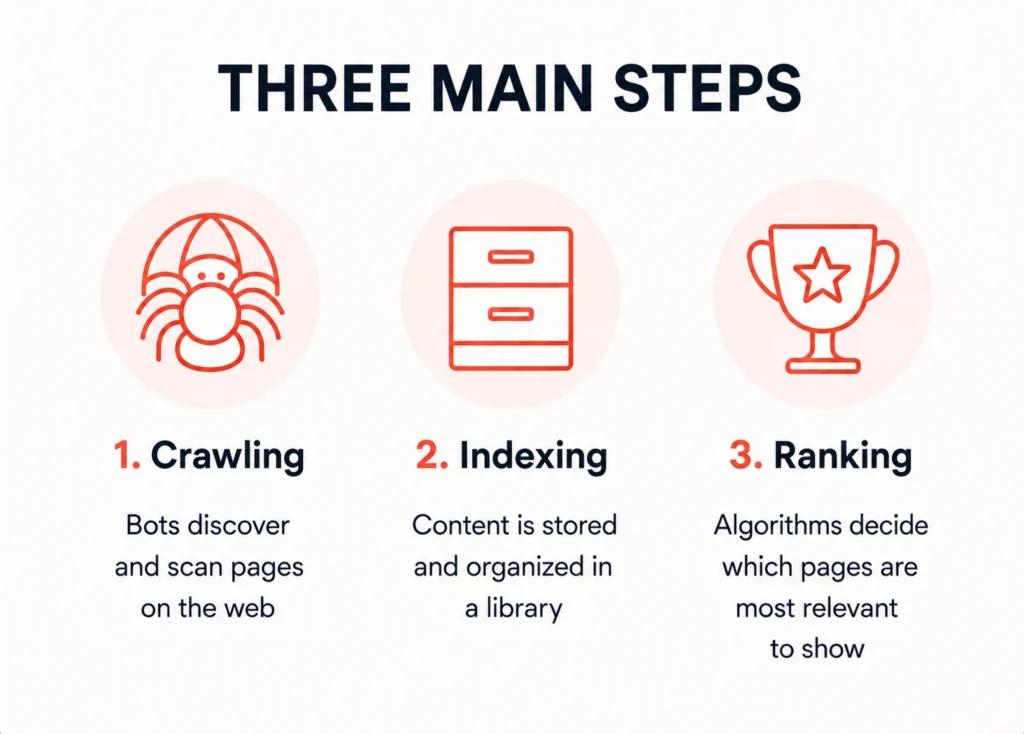
These three steps form the foundation of search engine basics. Every result you see in Google has gone through each of these stages.
While search results have evolved significantly in recent years, the underlying process remains largely the same. Whether Google displays traditional web results, AI-generated summaries, videos, images, maps, or other rich features, those experiences still depend on content being discovered, understood, and organized through crawling, indexing, and ranking.
Understanding the stages makes it much easier to understand why some websites appear in search results and others never show up at all.
Crawling: How Search Engines Discover Pages
The first step is crawling.
Search engines use automated programs called crawlers or spiders to discover pages across the internet. These bots move from page to page by following links, scanning content, and recording what they find.
Think of it like a librarian walking through every aisle of a massive library, noting which books exist and where they are located.
But not every page gets discovered automatically. Site structure plays a major role in how easily crawlers can find content. If pages are buried deep inside a website or not linked internally, they may never be crawled at all.
This is one of the first search engine basics that surprises business owners. If search engines cannot find a page, they cannot show it in results.
Indexing: How Search Engines Store Information
Once a page is discovered, the next step is indexing.
Indexing is the process of storing and organizing the information that was found during crawling. Search engines analyze the page content and add it to a massive database known as the search index.
You can think of the index like a giant digital library catalog. It stores information about billions of web pages so they can be retrieved quickly when someone performs a search.
Not every page that gets crawled is indexed. Pages may be excluded if they are blocked by site settings, contain duplicate content, or do not provide useful information.
This step is another key part of search engine basics. If a page is not indexed, it cannot appear in search results no matter how good the content is.
Ranking: How Search Engines Choose Which Pages Appear
Ranking is the final step, and it is the most complex.
When someone types a search into Google, the search engine scans its index and decides which pages should appear and in what order.
Google uses hundreds of signals to determine this. Some of the most important include:
- How relevant the content is to the search
- How trustworthy the website appears
- How helpful the content is for users
- How fast and usable the page is
These signals help Google decide which results will be the most useful for the person searching.
Understanding ranking is one of the most important search engine basics for business owners. It explains why two websites with similar information can perform very differently in search results.
“When I explain search engines to clients, I usually use a library analogy. The internet is like a massive library and Google is the librarian. Crawling is how the librarian discovers books, by walking the shelves and following references from one book to another. Indexing is how those books are cataloged so they can actually be found later. And ranking is the librarian’s judgment call — when someone asks for a book on a topic, which one gets handed to them first?”
— Jen Merritt, Think It First Strategy Lead
How Google Decides What’s “Relevant”
Ranking involves more than simply matching keywords. Google’s goal is to connect a search with the page that best satisfies what the person actually wants.
This idea is called search intent.
For example, someone searching “what is SEO” is likely looking for an explanation. Someone searching “SEO agency near me” is probably ready to hire a service provider.
Even though both searches contain the same core term, they will produce completely different results.
Search engines generally interpret intent in four categories:
- Informational – the user wants to learn something
- Navigational – the user is trying to reach a specific site
- Commercial – the user is researching options
- Transactional – the user is ready to take action
Understanding intent is one of the most important search engine basics for businesses creating content.
If a page targets the wrong type of intent, it may rank poorly or attract visitors who never convert.
Search Is Evolving Beyond Traditional Results
Search results today look very different than they did even a few years ago.
Google increasingly incorporates AI-generated summaries and other rich search experiences that help users find answers more quickly. Instead of simply matching keywords, search engines are becoming better at understanding topics, relationships, and context.
While the presentation of search results continues to evolve, the fundamentals remain the same. AI-powered search experiences still rely on content being crawled, indexed, evaluated for quality, and determined to be relevant before it can be surfaced to users.
Organic vs Paid Search
Many business owners assume that paying for ads will help their website rank higher organically.
While paid search and organic search operate in the same search environment, they are separate systems.
Organic search results appear because Google’s algorithm believes the page is the best answer to the query. Paid search results appear because an advertiser has chosen to bid on a keyword. Paid search can generate traffic immediately, but it does not directly improve organic rankings.
Understanding this distinction is another part of search engine basics that helps businesses make better marketing decisions.
Paid campaigns can help capture immediate demand, while organic visibility builds long-term discovery and authority.
Many successful companies invest in both.
What This Means for Your Website and Content
Once you understand how search engines work, a few practical implications become clear.
First, if Google cannot crawl your site properly, it will struggle to discover your pages.
Second, if your content does not match search intent, it may attract visitors who leave quickly or never convert.
Third, if your site lacks credibility signals such as strong content, useful information, and reputable links, rankings may be unstable even if you appear temporarily.
The rise of AI search has not replaced SEO fundamentals. Whether your content appears in traditional rankings or AI-generated results, search engines still need to discover, understand, and trust your content before it can be shown to users.
These search engine basics show why SEO is not just about keywords. It is about building a site that search engines can understand and users find genuinely helpful.
“Most clients see SEO as one-off efforts, focusing on adding keywords to a page or refreshing metadata. What actually matters far more is consistency: expanding the footprint of your site with new pages, useful content, and links over time. Focusing only on small tactics while neglecting content growth is like polishing the windows on a house that needs a new roof.”
— Jen Merritt, Think It First Strategy Lead
Technical structure, content strategy, and authority all work together.
Once you understand these search engine basics, many SEO decisions start to make more sense:
- Site structure affects whether pages can be crawled.
- Content quality influences whether pages are indexed and considered useful.
- And signals that indicate a site is trustworthy, such as links from other reputable websites, help determine which pages rank above others.
These fundamentals shape how websites are built, how content is written, and how businesses compete for visibility in search.
The TIF Perspective: Why We Start With Search
Understanding search is not just an SEO exercise. It shapes how businesses think about their entire digital presence.
When companies understand the fundamentals of how search works, they can make smarter decisions about website structure, content priorities, and marketing investments.
That is why we start with search engine basics when building digital strategies.
Before redesigning a website or launching campaigns, it helps to understand the search environment your business is operating in. From there, the strategy becomes much clearer.
If you’re planning a website redesign or evaluating your digital strategy, understanding how search works is an important starting point.
Schedule a strategy call with Think It First to explore where search opportunities exist for your organization.
Search No More.
Book a Strategy Intro Call.
Have Another
The TIF Flywheel™: Our Approach to Digital Growth
Discover our proven 5-pillar approach to digital growth. From strategy to conversions, learn how our Growth Plans drive measurable results for businesses.
Choosing a Web Design Agency
Learn why choosing a web design agency is an investment decision, and how the right process and architecture support long-term growth.
How to Use a Website Checklist to Optimize Your Digital Strategy
A well-structured website is the key to an optimized digital strategy. It’s a powerful tool for lead generation, brand authority, and sales growth. Yet, many B2B marketers struggle to manage their website effectively while juggling other responsibilities. From optimizing for SEO to ensuring your UX creates a seamless user journey, maintaining a high-performance site is no small feat.
Local Service Ads: What They Are, How They Work, and Whether They’re Right for Your Business
Learn what Local Service Ads are, how they work, and whether they make sense for your business. A practical guide to Google’s pay-per-lead ad format.