

Many companies only realize their content management system (CMS) has become a business problem when everything starts feeling harder than it should.
When landing pages take weeks to launch, simple content updates require developer time, and campaigns get delayed, it’s because systems don’t connect cleanly. Marketing teams start working around the platform instead of with it.
At some point, the website stops feeling like a growth tool and starts feeling like infrastructure nobody wants to touch. (Or worse — everyone is scared to touch.)
The problem usually isn’t a single broken feature but rather the underlying architecture.
Many traditional CMS platforms were built for a much simpler digital environment — one website, one frontend experience, one publishing workflow. But modern businesses don’t operate that way anymore.
Content now needs to move across websites, apps, portals, campaigns, CRMs, analytics platforms, and AI-driven systems. The more connected the business becomes, the more that these rigid, traditional CMS platforms create operational friction behind the scenes.
Many manufacturers still rely on older inventory, order-management, CRM, or other operational systems that the website needs to access. That makes legacy system integration an important part of CMS planning.
To overcome this friction, headless CMS architecture is increasingly becoming part of digital transformation for manufacturers. Rather than a technical bottleneck, this approach offers operational freedom—aligning with the need for speed, flexibility, scalability, and marketing agility.
Wrapping Your Head Around “Headless”: What Is a Headless CMS?
At its simplest, a headless CMS separates content management from the frontend website experience.
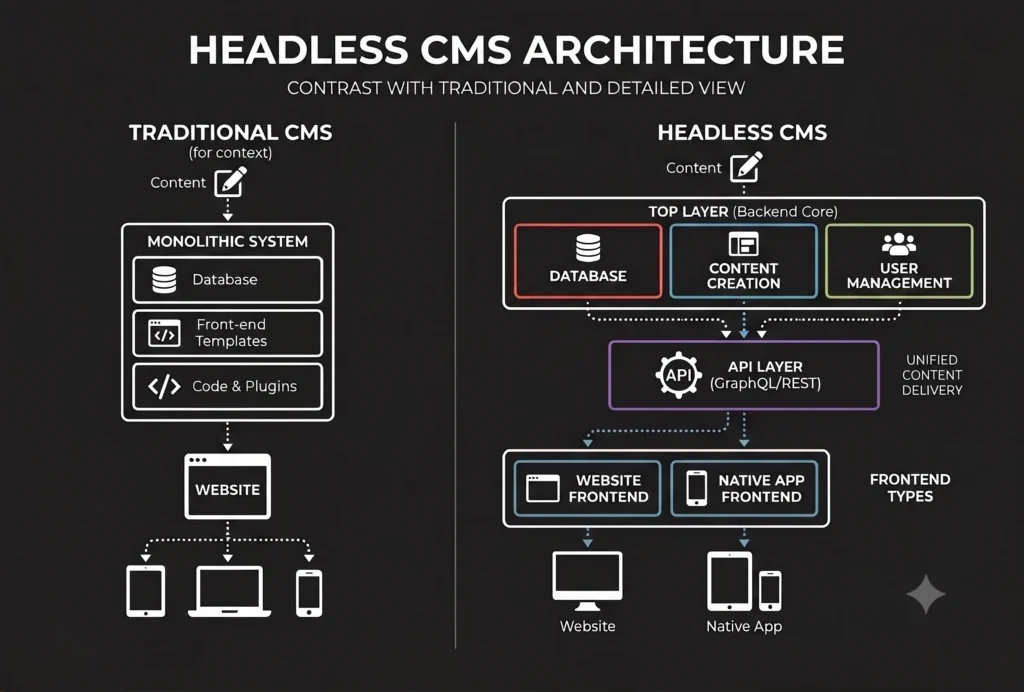
The CMS still stores and manages content such as page copy, blog posts, product information, images, resources, and media assets.
But instead of also controlling exactly how that content gets displayed on the website, the frontend experience is built separately using modern frameworks and connected through APIs. That means the website, customer portal, mobile app, ecommerce experience, or other digital platforms can all pull from the same content system while evolving much more independently.
That flexibility becomes especially important in industrial web design, where websites often support far more than marketing alone. Product brochures and catalogs, sales tools, gated resources, CRM connectivity, ERP integration, distributor experiences, customer portals, and multi-step buyer journeys all create additional complexity behind the scenes.
As those systems grow, tightly connected platforms can become harder to scale, update, and work within efficiently. A headless CMS allows teams to launch new experiences, redesign frontend interfaces, improve performance, or expand into new platforms without constantly reworking the underlying structure.
A headless CMS can also make B2B SEO easier to execute by allowing marketing teams to publish and update search-focused content without waiting on developers.
Think of it less like one giant system trying to do everything and more like specialized, interconnected systems working together more efficiently.
For leadership teams, it creates infrastructure that scales with the business rather than slowing it down.
What Changes When Your CMS Stops Controlling Everything
In many traditional CMS environments, even small updates can create a surprisingly long chain reaction.
Marketing needs development support.
Development needs QA.
Plugins create compatibility issues.
Templates become difficult to modify without affecting other parts of the site.
That friction becomes especially noticeable in B2B industrial marketing, where teams are constantly updating product information, launching campaigns, managing gated resources, or supporting multiple customer journeys simultaneously.
A headless approach creates more separation between the content system and the frontend experience.
That means teams can redesign sections of the website, launch new digital experiences, improve performance, or expand into new platforms without rebuilding the entire CMS structure underneath them every time the business evolves.
Different parts of the digital experience can evolve more independently without disrupting the entire platform.
In many cases, the bigger improvement is how quickly teams can execute.
Signs You May Have Outgrown Your CMS
Not every company needs a headless architecture.
But many businesses start exploring it after running into the same operational frustrations repeatedly:
- Marketing updates constantly require developer support.
- Launch timelines keep getting longer.
- Performance improvements become difficult to implement cleanly.
- New plugins create unexpected conflicts.
- Different teams duplicate content across systems.
- Launching new digital experiences requires rebuilding existing infrastructure.
- The website becomes harder to maintain as the business grows.
In manufacturing website design, those slowdowns can become especially noticeable as websites expand to support product catalogs, customer resources, sales enablement tools, gated content, portals, integrations, and increasingly complex buyer journeys.
None of these problems automatically mean a company needs to move to a headless CMS.
But they are often signs that the underlying architecture is starting to create friction as the business evolves.
Moving to Headless Doesn’t Have to Happen All at Once
One of the biggest misconceptions about a headless approach is that it requires rebuilding everything from scratch all at once.
In reality, many companies gradually move toward a headless approach.
Some start by decoupling only the frontend experience while keeping their existing CMS in place behind the scenes. Others begin with a specific section of the website, such as a resource center, product catalog, campaign landing page, or customer portal. For organizations using WordPress, custom WordPress development can provide a phased path to headless architecture without requiring an immediate platform replacement.
That phased approach allows teams to improve performance, test new workflows, and modernize infrastructure without disrupting the entire digital ecosystem at once. It also gives companies the opportunity to identify what’s actually creating friction before investing in a larger B2B digital transformation.
Phasing can make digital transformation for small business more manageable by reducing upfront cost and disruption.
In many cases, the goal is not to replace every system immediately; it’s to create a more flexible foundation that can evolve more cleanly as the business grows.
For B2B organizations managing complex buyer journeys, multiple integrations, large content libraries, or expanding digital experiences, that kind of flexibility can make it much easier to scale without having to rebuild infrastructure every few years.
Choosing the Right Partner for a Headless Transition
Not every company needs to move to a headless CMS immediately.
And the most successful transitions usually don’t start with choosing technology first.
They start with understanding how content, systems, teams, and customer experiences already interact behind the scenes.
Where are the bottlenecks?
What experiences need to scale?
Which systems are creating friction?
What actually needs more flexibility?
Those answers shape whether a headless approach makes sense, how complex the transition should be, and which parts of the ecosystem should evolve first.
At Think It First, those conversations typically start with a Digital Roadmap focused on understanding operational needs, technical dependencies, content workflows, and long-term business goals before major platform decisions are made.
The focus is on building infrastructure that can support where the business is headed next.
Start With a Digital Roadmap
If your team is evaluating whether a headless CMS makes sense, the first step is understanding where your current platform is failing you every day and what your business actually needs to support the next phase of growth.
Schedule a strategy session with Think It First to map content workflows, technical dependencies, and growth priorities before making major platform decisions.
Let’s build a digital foundation that can support future growth without becoming harder to manage over time.
Meet your New Digital Co-pilots.
Book a Strategy Intro Call.
Have another…
Beyond the Builder: Why a Custom WordPress Theme is Your Site’s Secret Weapon
Drag-and-drop builders like Elementor and Divi slow your site down. A custom WordPress theme makes you a marketing machine. Here’s why.
The Harsh Truth About CRO: More Traffic ≠ More Revenue
B2B leaders: stop chasing clicks. Discover how optimizing website conversion paths, lead nurturing, and the marketing funnel drives real revenue.
5 Signs It’s Time to Invest in a Digital Roadmap
Is your B2B digital strategy reactive instead of proactive? Discover the key signs you need a digital roadmap to streamline growth & reduce costly mistakes.
What Does a B2B Manufacturing Website Cost?
Stop scoping websites by page count. Learn how to budget by business outcomes and system complexity to build a site that drives real revenue.