


Most B2B companies don’t have a competition problem. They have a sameness problem.
When every company promises better service, higher quality, and deeper expertise, websites and sales conversations start to blur together. Buyers stop seeing meaningful differences and fall back on comparing capabilities, timelines, and price.
Blue Ocean Strategy offers another path: change the perspective enough that the usual comparisons start to break down.
What Blue Ocean Strategy Actually Means
Blue Ocean Strategy is about creating an uncontested market.
For most B2B companies, it’s a little less dramatic than that.
You’re probably still selling to many of the same buyers as your competitors. The difference is that you may not be competing in exactly the same way.
Instead of trying to win an exhausting comparison game, companies employing Blue Ocean thinking often look for ways to change how buyers experience, evaluate, and understand their value.
Even strong companies can start feeling more interchangeable than they really are.
Often, there are also long-standing frustrations or limitations that everybody has quietly accepted as normal.
Buyers have learned to tolerate friction that nobody questions anymore. Long sales cycles. Internal processes that make it harder for the customer. Hidden information that should be readily available because “that’s how the industry works.” Over time, those patterns can become so familiar that people stop questioning them.
Blue Ocean thinking starts by looking at those assumptions more closely.
Not just: “How do we market this better?”
But: “Does this experience actually have to work this way?”
In many cases, the companies that stand out are the ones willing to remove the friction others became complacent with years ago.
What This Looks Like in Practice
We’ve seen this happen firsthand with clients navigating crowded, highly competitive categories where the products themselves aren’t necessarily the problem. The buying experience is.
One example is Trex and the launch of its spiral stairs product line.
In a crowded building-materials category, customers were often forced into an uncomfortable trade-off: either visit a showroom to visualize options in person or buy online with little confidence in the final result.
Most competitors treated that experience as normal.
Instead of trying to message their way around the frustration, Trex changed the experience itself.
The configurator Think It First developed allowed buyers to explore materials, finishes, dimensions, and configurations interactively and in real time. The shift wasn’t just functional. It changed how customers engaged with the product and how they evaluated the purchase.
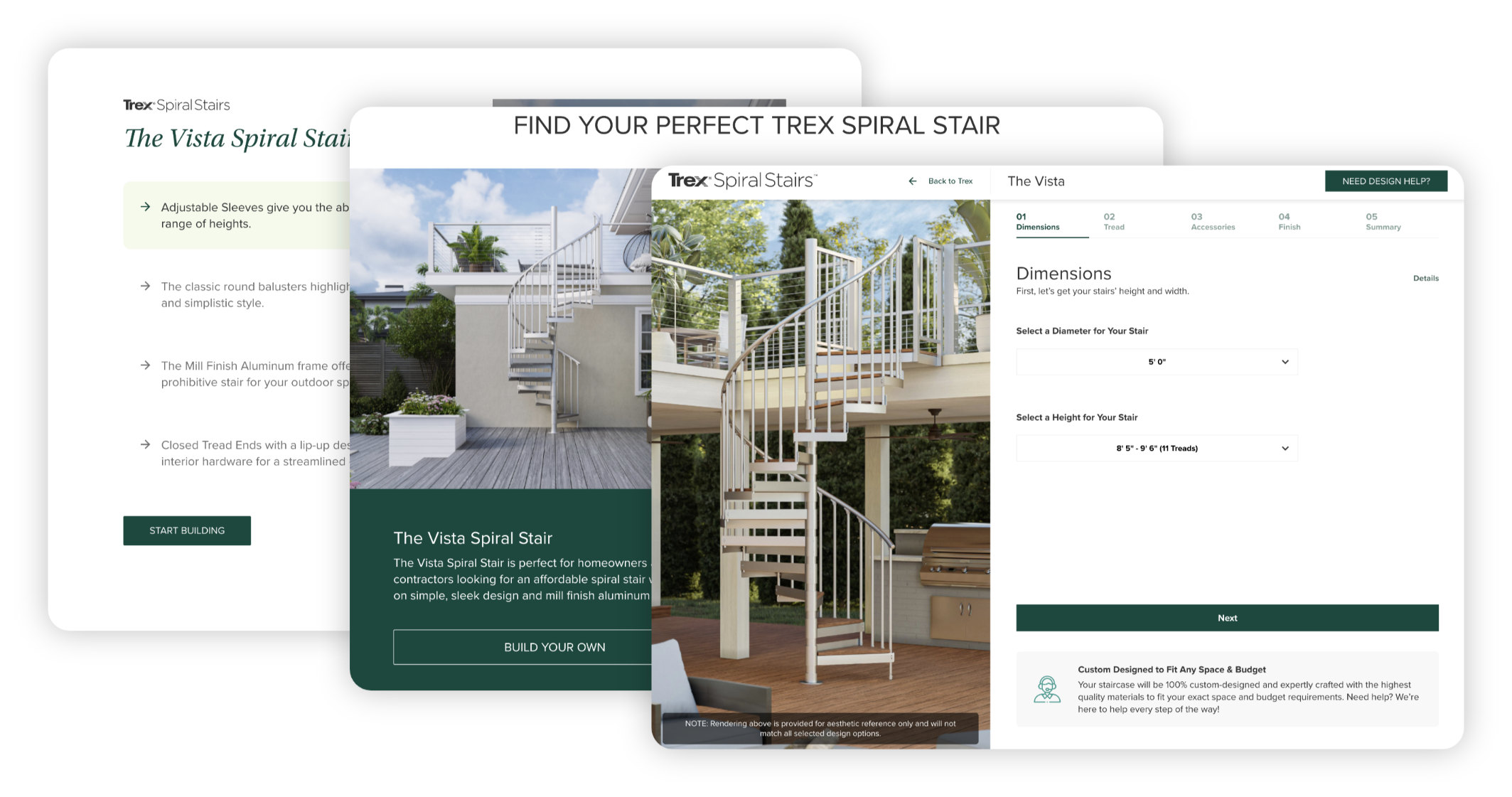
While Trex was still competing in the same category, they changed the plane.
They gave customers a way to envision the final product before purchasing, turning what had traditionally been a high-friction, low-confidence buying process into something interactive, visual, and immediate.
That’s often what makes a Blue Ocean move feel different. The product category may stay the same, but the customer experience and expectations around it start to change.
Blue Ocean Opportunities Hide in Buyer Behavior
One challenge with Blue Ocean thinking is that opportunities rarely announce themselves clearly.
Most companies are too close to their own processes to notice where buyers feel friction, uncertainty, or confusion.
Internal teams adapt to workflows over time. Industry assumptions start feeling permanent. Even customers stop expecting better experiences because they’ve learned to navigate the same limitations everywhere.
That’s why some of the strongest opportunities come from studying how buyers actually behave rather than relying solely on internal assumptions about what matters.
- Where do buyers hesitate?
- What part of the process creates difficulty?
- What questions repeatedly surface during sales conversations?
- What information are customers trying to piece together on their own before they ever contact your team?
Those patterns often reveal where expectations are changing faster than the industry itself.
The opportunity isn’t inventing something entirely new. It’s recognizing a problem competitors have stopped noticing.
The Think It First Point of View
Blue Ocean opportunities rarely come from brainstorming sessions where companies sit around trying to “be disruptive.”
More often, they emerge from studying buyer behavior, calling out friction for what it is, and red-flagging the assumptions the industry has stopped questioning.
That’s why strategy has to come before execution.
Without revisiting the thinking, a redesign alone won’t solve an underlying buying experience that still feels interchangeable. More campaigns won’t create differentiation if you operate within the same expectations.
The goal isn’t simply to look different. It’s to change the perception of the value your solution creates.
That’s a big part of why Digital Roadmaps are part of the process at Think It First. Before jumping into tactics, design, or development, we work with our clients to uncover where opportunities for differentiation already exist, where you fall into the sea of sameness, and where customer expectations may already be shifting.
Sometimes the biggest opportunity isn’t competing harder. It’s recognizing that the market may be ready for an entirely different experience.
If you’re trying to uncover where your business may be blending in instead of standing out, schedule a strategy call with the Think It First team. We can discuss how a Digital Roadmap might help identify opportunities for smarter differentiation.
Meet your New Thinking Partner.
Book a Strategy Intro Call.
More like this
AI in the B2B Buyer Journey: What Really Drives Pipeline (and How to Spot the Hype)
Some AI tools genuinely improve the buyer experience. Others create more overhead than value. Here’s how smart B2B teams evaluate the difference.
Technical Specs Don’t Create Buyers. Operational Challenges Do.
Stop leading with specs. Shift to problem-first marketing for stronger engagement, fewer B2B copywriting mistakes, and a manufacturing content strategy that converts.
How to Use a Website Checklist to Optimize Your Digital Strategy
A well-structured website is the key to an optimized digital strategy. It’s a powerful tool for lead generation, brand authority, and sales growth. Yet, many B2B marketers struggle to manage their website effectively while juggling other responsibilities. From optimizing for SEO to ensuring your UX creates a seamless user journey, maintaining a high-performance site is no small feat.
The Harsh Truth About CRO: More Traffic ≠ More Revenue
B2B leaders: stop chasing clicks. Discover how optimizing website conversion paths, lead nurturing, and the marketing funnel drives real revenue.