

We spend a lot of time helping clients improve their digital marketing performance. We analyze campaigns, refine targeting, and help companies understand what their data is really telling them.
So when I pulled up Think It First’s own Google Ads account, I expected to feel pretty good about what I saw.
I didn’t.
A closer PPC audit showed that one keyword was doing most of the meaningful work.
Ninety days of data. One keyword — “website design services” — generated 250 clicks and 45 conversions. An 18% conversion rate. Real buying intent, real results. Those clicks represented people actively looking for the services we offer.
This wasn’t a sophisticated marketing attribution model. It was a straightforward look at which searches generated clicks and conversions, and whether those conversions reflected real buying intent.
Then I looked at the rest of the report.
Keywords related to website builders, hosting platforms, and broad design terms generated impressions. Some generated clicks. Almost none generated meaningful business.
The clicks were real.
The people were real.
They just weren’t the right people, searching with the right intent, at the right point in their buying journey.
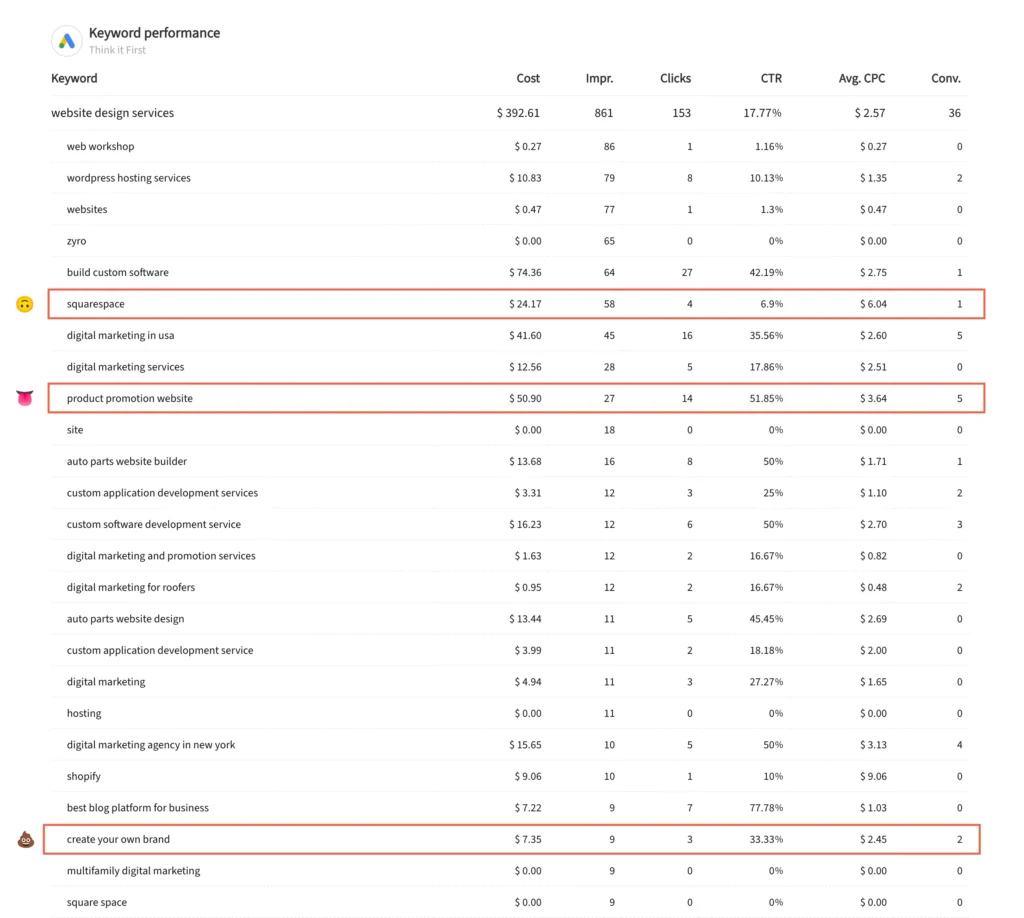
What surprised me wasn’t that the campaigns were “failing.” They weren’t. They were generating impressions, attracting clicks, and putting us in front of real people. It was realizing how much we’d been paying for activity instead of intent.
Traffic Feels Like Progress
Here’s the interesting part. This wasn’t really a story about Google Ads.
Traffic is satisfying to look at. A dashboard full of impressions and clicks feels like progress. It’s visible, it’s countable, and it’s easy to report on in a meeting.
But ad performance analysis can’t stop at traffic.It needs to show whether the right people are finding you, understanding what you do, and taking the next step.
A thousand visitors who were never looking for your services won’t grow your business. One hundred highly qualified visitors who arrive with genuine buying intent might.
Those are very different outcomes, even if the dashboard makes one look more impressive than the other.
Visibility Is About Intent
Visibility is a different goal. Visibility means showing up specifically — in front of the people who are actually evaluating a decision you can help them make. It’s less about how many people see you and much more about who sees you, when, and what they find when they do.
The keyword that performed best for us reflected a very specific need.
Someone searching for “website design services” has likely moved beyond curiosity. They’re evaluating providers, comparing options, and trying to solve a real business problem.
That’s a very different search than someone looking for a website builder, a hosting platform, or a broad design term. Those are all topics we’re knowledgeable about. We build websites, work with hosting platforms, and help clients make those decisions every day. It makes sense that our ads appeared for some of those searches.
The problem wasn’t broad relevance. It was intent. Those searchers weren’t looking for an agency to solve their problem. There was a mismatch. Our ads were reaching real people, just not the people most likely to become customers.
We don’t need to show up for every search. We need to show up for the right searches. Visibility, not volume, is what actually grows a business.
What We’re Changing: Ad Spend Optimization Based on Intent
Looking at our own data forced us to rethink a few assumptions.
We’re refining our paid media strategy and marketing budget allocation by focusing our keywords and spend on genuine buying intent.
We’re taking another look at how our landing pages align with the searches that bring people to our site.
That alignment is central to conversion funnel optimization, the keyword, ad, landing page, and next steps should all reflect the same intent.
And we’re continuing to build content that answers the questions our ideal clients are already asking, because paid search performs best when it’s supported by a thoughtful content strategy rather than carrying the entire burden.
We don’t see it as SEO vs PPC. Organic content and paid campaigns should reinforce each other by answering the same high-intent questions.
The Better Question
Most companies ask:
“How much traffic did we get?”
After looking at our own data, I think there’s a better question:
“How much of that traffic could realistically become a customer?”
If you work with a Google Ads agency, that is the question its reporting should help you answer.
That’s the question our report forced us to answer.
The answer prompted some meaningful changes.
If your own dashboard looks healthy but your pipeline tells a different story, it might be worth asking the same question.
Want more visibility?
Book a Strategy Intro Call.
Learn More…
The Harsh Truth About CRO: More Traffic ≠ More Revenue
B2B leaders: stop chasing clicks. Discover how optimizing website conversion paths, lead nurturing, and the marketing funnel drives real revenue.
How Search Engines Work: The Basics Every Business Owner Should Know
Learn search engine basics, including crawling, indexing, and ranking, and how Google decides which pages appear in search results.
Local Service Ads: What They Are, How They Work, and Whether They’re Right for Your Business
Learn what Local Service Ads are, how they work, and whether they make sense for your business. A practical guide to Google’s pay-per-lead ad format.
Technical Specs Don’t Create Buyers. Operational Challenges Do.
Stop leading with specs. Shift to problem-first marketing for stronger engagement, fewer B2B copywriting mistakes, and a manufacturing content strategy that converts.